NBA Player Props Betting UK: Markets and Odds
 Available in US
Table of Contents
- NBA Props in the UK: Market Growth and Betting ROI
- The Five Things That Will Improve Your Next Prop Slip
- What an NBA Player Prop Actually Is
- The Core Prop Markets Explained: Points, Rebounds, Assists, PRA and More
- UK Fractional, Decimal and American Odds: How to Read a Prop Line
- Expected Value, Vig and the 52.4% Break-Even Rule
- Choosing a UK-Licensed Sportsbook for NBA Props
- What UK Regulation Means for Your Prop Slip in 2026
- Why UK Demand for NBA Props Has Exploded
- A Pre-Bet Workflow: From Box Score to Confirmed Slip
- Integrity, the Rozier Case and What It Changed for Prop Menus
- Responsible Gambling Tools UK Bettors Should Actually Use
- Where to Go Deeper: Strategy, UK Scene, Integrity and Tools
- Frequently Asked Questions About NBA Player Props in the UK
- Closing the Slip: Discipline Beats Picks

NBA Props in the UK: Market Growth and Betting ROI
The first NBA prop slip I ever placed in pounds, not dollars, settled on a Sunday morning in November. London was dark by four, the Lakers were tipping off at one in the morning my time, and the line on the centre’s rebounds looked two boards too low. It hit. That was a decade ago, and back then almost nobody in Britain framed basketball as a serious betting market. Now my evenings are crowded with UK bettors asking the questions I once asked alone.
The shift is no longer subtle. NBA viewership on Prime Video in the UK climbed 444% year on year in the 2025-26 season, and the EY-Parthenon Sports Engagement Index 2025 lifted basketball seven places to thirteenth overall, with sixth among Gen-Z aged 18 to 24. Those numbers describe a sport crossing into the British mainstream while the betting market is still catching up.
I am writing this guide for the bettor who has stopped placing accumulators on Premier League weekends and started looking at NBA player specials on a Tuesday night. You want to know what a player prop actually is, how the maths under the odds works, which UKGC-licensed operators are worth your account verification, and what the regulator changed in 2025. That is the territory I will cover.
What this guide does not do. No daily picks. No leans on tonight’s slate. The lines move four times before tip-off and any specific call here would be stale before the page loaded. What you get instead is a framework that survives the schedule: market structure, odds maths, UK regulation, sportsbook selection and a pre-bet workflow you can run on any night of the season.
Props are the fastest-growing corner of UK NBA betting because they suit how British bettors already think. You watch a player, form an opinion on whether his rebounds will be over or under a number, place a single line. No parlay-leg dependency, no spread to chase, no half-time swing to nurse. The bet stands or falls on one performance. That clean accountability is what makes props addictive in the wrong way and lucrative in the right way.
The Five Things That Will Improve Your Next Prop Slip
- A prop is a bet on a single player’s stat line, not the game result, so research time goes into one player rather than five outcomes.
- At standard prop odds of 10/11 fractional or 1.91 decimal, you need a true win rate of 52.4% just to break even, and anything below that bleeds the bankroll over time.
- Hit rates vary sharply by stat: blocks landed at 69.9% across a 10,580-prop sample for 2025-26, while PRA combos managed only 54.7%, so the easier markets are not always where you think.
- UK bettors operate inside a specific regulatory frame in 2026: the 1.1% statutory levy on remote operators, RTS 12 deposit-limit rules and the GSGB participation surveys all shape what a UKGC sportsbook can show you.
- Sportsbook selection is a tooling decision, not a brand decision: prop menu depth, alt-line availability and licence status matter more than the welcome offer.
What an NBA Player Prop Actually Is
A friend rang me at half-time of a Knicks-Celtics fixture last October asking why Adam Silver had told the Prime camera, “There’s nothing more important to the league and its fans than the integrity of the competition, so I had a pit in my stomach. It was very upsetting.” He was confused why a Commissioner whose league prints money on prop bets sounded sick about them. The answer is in the definition. A prop puts a single number on a single human, and that intimacy is what makes the market both compelling and fragile.
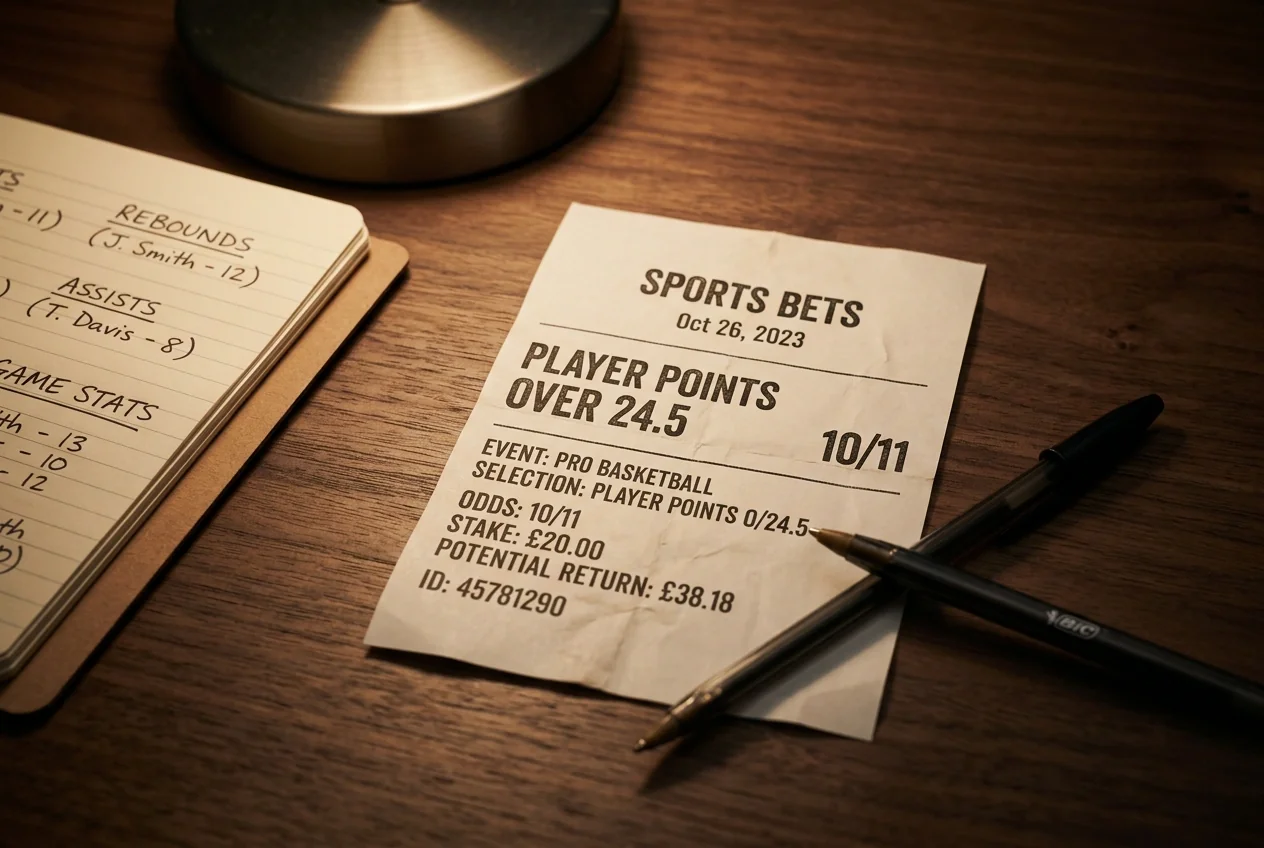
An NBA player prop is a bet on what an individual player will do, not on what either team will do. It has nothing to do with who wins, who covers the spread, or how many points the two sides combine for. You are pricing whether a specific man will score over or under a number of points, grab over or under a number of rebounds, dish over or under a number of assists. The line and the odds together encode the bookmaker’s read on probability, and your job is to disagree with that read profitably.
Proposition bet — any wager on an outcome inside a fixture rather than the fixture’s result. Player props are the subset where the outcome belongs to one named athlete. UK sportsbooks often label these markets “player specials,” but the structure is identical.
The mechanic is binary. The book sets a line, say 24.5 points. You back over or under. 25 or more, the over wins. 24 or fewer, the under wins. The half point eliminates pushes, which is why almost every prop line ends in .5. Yes/no formats also exist for double-doubles or triple-doubles, with no line at all.
What makes the market different from spreads is research surface. A spread on a Lakers game asks you to model two five-man units, two coaching staffs, foul trouble. A points prop on one Lakers wing asks you to model one player’s minutes, usage, matchup and recent form. The information density per unit of edge is much higher on the prop. That is why I gravitated here years ago and why I have stayed.
Player props are not derivative micro-bets. They are not “first basket scorer,” “race to 10,” or quarter-by-quarter player markets. Those are micro-markets with their own integrity exposure, which I pick up later. When I say “prop” here, I mean the standard full-game over/under on a counting stat.
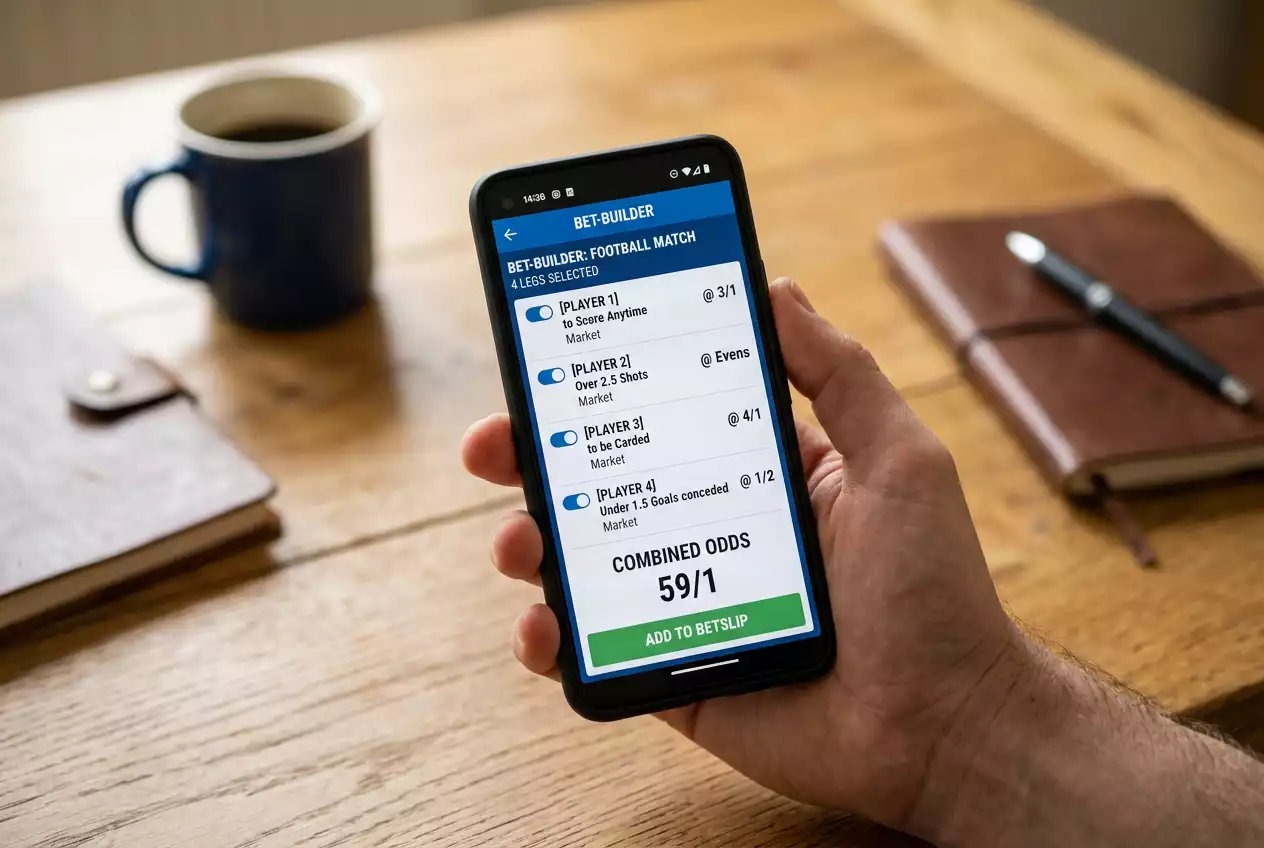
UK and US bettors use slightly different vocabulary. “Player specials” on a Sky Bet menu is “player props” on a DraftKings page. “Same game multi” is the British equivalent of “same game parlay.” The maths does not change with the label. The licence and consumer protection regime do, which is where UK regulation starts to matter.
The Core Prop Markets Explained: Points, Rebounds, Assists, PRA and More
A points prop and a blocks prop look identical on a betting slip. They are nothing alike under the surface. Hit rates, variance and bookmaker accuracy diverge sharply across the menu, and the bettor who treats every stat the same is leaving real money on the table.

Across a sample of 10,580 NBA props for the 2025-26 season, the spread by stat type was striking. Blocks landed at 69.9%, threes at 63.2%, steals at 61.9%, points at 55.7% and PRA combos at 54.7%, with an overall win rate of 56.8%. The harder a stat is for a single book to model, the more the line moves at the margins, and the more often a sharp read finds value.
Points
The flagship market. Every NBA player who clears the rotation threshold has a points line on a UK book, set primarily by minutes projection multiplied by usage and efficiency, with adjustment for opponent defence at position. Points props are the most heavily traded and therefore the sharpest. Beating the market consistently means moving early on injury news, not late.
Rebounds
A rebound is the result of a missed shot, a positional contest, and a touch. That chain makes rebounds more variable than points. Rebound props are looser, with bigger half-point gaps between alt-lines and more operator-to-operator disagreement. The classic angle is a centre facing a high-volume three-point team in a fast-paced fixture, where missed threes inflate defensive rebound opportunity.
Assists
The most coach-dependent stat in the box score. Whether a set of passes counts as an assist depends on the scorer’s finishing rate and how the team runs its half-court offence. Lines are wider on assists than on rebounds. The play here is rarely the star point guard — it is the secondary creator on a team where the lead guard sits, and books underestimate how much creation responsibility shifts.
PRA and combination markets
PRA — points plus rebounds plus assists, the most common combination prop on UK menus. Includes overtime by default on most operators. Half-point lines mean a push is impossible.
PRA had the lowest hit rate in the 2025-26 sample at 54.7%, barely above the 52.4% break-even rate. The market is efficient because aggregation across three stat lines smooths variance.
Threes, blocks and steals
The high-variance markets. Blocks at 69.9% hit rate is not a coincidence — the stat is rare, lines cluster around 0.5 or 1.5, and a single defensive sequence settles the bet. Threes at 63.2% reflect three-point volume stabilising league-wide. The rarer the stat, the more the prop behaves like a coin flip with a small lean for sharper bettors, and the slower the books move the line.
Yes/no markets and derivatives
Double-double and triple-double yes/no markets quote a price on whether the player records 10+ in two or three counting categories. These are correlated parlays priced as singles, with operator hold typically higher than on flat over/unders. Occasionally beatable when a centre’s rebound floor is dramatically underrated, otherwise mostly recreational.
| Stat type | 2025-26 hit rate | Variance | Strategic angle |
|---|---|---|---|
| Points | 55.7% | Moderate | Move early on injury or rotation news, not late |
| Rebounds | ~58% | High | Pace plus opponent shot diet drives the line gap |
| Assists | ~57% | High | Target secondary creator when lead guard is out |
| PRA combo | 54.7% | Low | Tight market, look for outliers in alt-lines instead |
| Threes made | 63.2% | High | Volume trend has stabilised, watch three-point defence |
| Steals | 61.9% | Very high | Perimeter defenders against turnover-prone offences |
| Blocks | 69.9% | Very high | Rim protectors versus high-rim-frequency offences |
The menu is not a level playing field. A bettor who spreads attention evenly across all seven markets is treating them as if they were equally efficient. They are not. The structure rewards specialisation. For the strategic depth on how pace, usage and defence-versus-position translate into edge, that is the territory of our deeper guide on building an NBA prop strategy.
UK Fractional, Decimal and American Odds: How to Read a Prop Line
I once watched a Manchester-based bettor stare at “−110” on a US sportsbook screenshot for thirty seconds before asking me whether that was the price or the player’s defensive rating. He had bet on football for fifteen years, never on basketball, and his eyes refused to parse a negative number as odds. Most NBA prop content on the open web is written for the American market. UK books quote in fractional odds by default and decimal on toggle. If you cannot move fluently between all three formats, you cannot read your own betting environment.
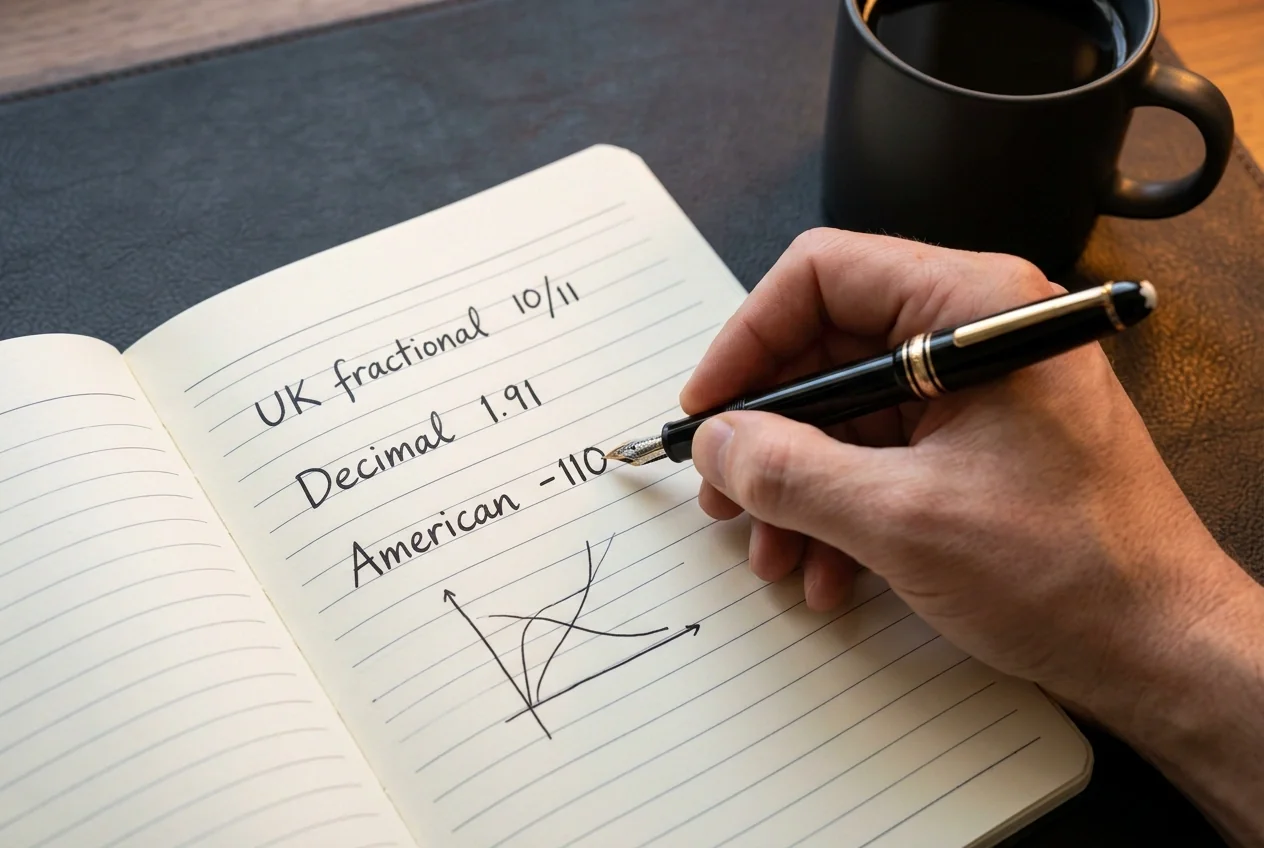
UK fractional odds express the profit ratio: 10/11 means a £11 stake returns £10 profit, plus stake back, for a £21 total payout. Decimal odds express total return per unit staked: 1.91 means a £1 stake returns £1.91 total, including the stake. American odds use −110 to mean you risk £110 to win £100. All three describe the same probability, dressed differently.
One price, three notations
A standard prop line at the bookmaker’s house odds:
- UK fractional: 10/11
- Decimal: 1.91
- American: −110
Implied probability for all three: 52.4%.
To get implied probability from decimal odds, divide 1 by the decimal: 1 ÷ 1.91 = 0.524, or 52.4%. From fractional odds, take the denominator divided by numerator-plus-denominator: 11 ÷ (10 + 11) = 0.524. From American negative odds, the absolute value over itself plus 100: 110 ÷ 210 = 0.524. Three roads, one number.
That implied probability is the break-even rate I keep coming back to. At 1.91 decimal, you need a true win probability of at least 52.4% to break even before commission. Knowing that line in your head is the difference between a bettor with a process and one shopping for vibes.
Worked example: converting a UK prop line to implied probability
You see a points-over line on a UK book at 10/11.
Convert to decimal: 10/11 = 0.909, plus 1 = 1.909, rounded to 1.91.
Convert to implied probability: 1 ÷ 1.91 = 0.5236, or 52.4%.
Ask yourself: do I genuinely think this player goes over more than 52.4% of the time tonight, given minutes, opponent defence and pace? If yes, the bet has positive expected value. If no, walk away.
UK fractional odds become awkward at unusual prices. 5/6, 4/5, 11/10 and 6/4 are common around the standard −110 region. The mental conversion to decimal is always the same: numerator divided by denominator, plus one. 6/4 becomes 1 + 1.5 = 2.50. 5/6 becomes 1 + 0.833 = 1.83. The full calculator stack — implied probability, no-vig fair value, EV maths and Kelly sizing applied across UK books — is the focus of the calculators and maths companion to this guide.
Expected Value, Vig and the 52.4% Break-Even Rule
If a coin came up heads 53% of the time, would you bet on it at even money? Most people say yes, then hesitate when they realise the edge sounds tiny. It is tiny. It is also enormous. Casinos are built on edges of two or three percent. The 52.4% break-even rate at standard prop odds is the wall every bettor walks into.
Expected value is the average amount a bet makes or loses if you placed it thousands of times at the same price. As one analyst put it: “You calculate expected value by multiplying the probability of each outcome by its payout, then adding those results together. If the total is positive, it’s a +EV bet.” That sentence is the entire game.
The vig is the bookmaker’s commission baked into the price. At 1.91 decimal on both sides of an over/under, the implied probabilities sum to 104.8%. The 4.8% over 100% is the cut. That extra cost is why true probability needs to clear 52.4% rather than the obvious-feeling 50%.
Worked example: an EV calculation on a single prop
The setup. A points-over line at 1.91 decimal. Your model says the player goes over 56% of the time tonight. £100 stake.
Probability of winning: 0.56. Probability of losing: 0.44.
Profit if won: £91. Loss if lost: £100.
EV = (0.56 × £91) − (0.44 × £100) = £50.96 − £44.00 = +£6.96 per £100 staked.
An EV of +5% on a unit stake at these odds delivers a long-run ROI of roughly five pence per pound staked. The +6.96% sits above the 5% threshold I use to mark a bet as worth the slip.
Anything under 52.4% true win rate at standard prop odds bleeds bankroll. Anything above 52.4% builds it. The harder problem is being honest about whether your edge estimate is real or a story you are telling yourself.
That last point is one I keep relearning. As one editorial put it, “Uncertainty is part of the analysis. Don’t pretend you know true probability with precision you don’t have.” If your estimate range overlaps the implied probability of the line, the bet is a coin flip dressed up as analysis. If your range sits cleanly above it with room to spare, you have a real edge.
NBA Prop EV & Kelly Calculator
Convert odds, strip out the vig, size your stake, and check hit rates by stat type.
No-vig fair value strips the bookmaker’s margin out of both sides so you can see what the market would price if it were a 100% book — useful for judging whether your own edge estimate is realistic.
2025-26 season, 10,580-prop sample. Break-even at standard -110 / 10/11 odds is 52.4% — every market below clears it, but by very different margins.
Historical hit rates describe the field, not tonight’s game. Use them to prioritise research time, not to skip forming your own probability estimate.
Simplified educational model. Kelly sizing is a mathematical ceiling, not a recommendation to stake that much — most bettors should use half Kelly or smaller. Not a guaranteed predictor. For informational purposes only. 18+ Please gamble responsibly.
Vig also varies by market. UK books hold tighter on points and PRA props because they are heavily traded, and looser on blocks and steals because they are not. The implied total can hit 108% on rarer markets, which means break-even moves up from 52.4% to roughly 54%. Always check the implied probability on both sides before assuming the standard rate applies.
Choosing a UK-Licensed Sportsbook for NBA Props
The single worst question a UK bettor can ask me is, “Which is the best bookmaker?” There is no answer to it that is not misleading. There is only the right tool for what you are trying to do, the right licence for the country you live in, and the right account for the bankroll you are working with.
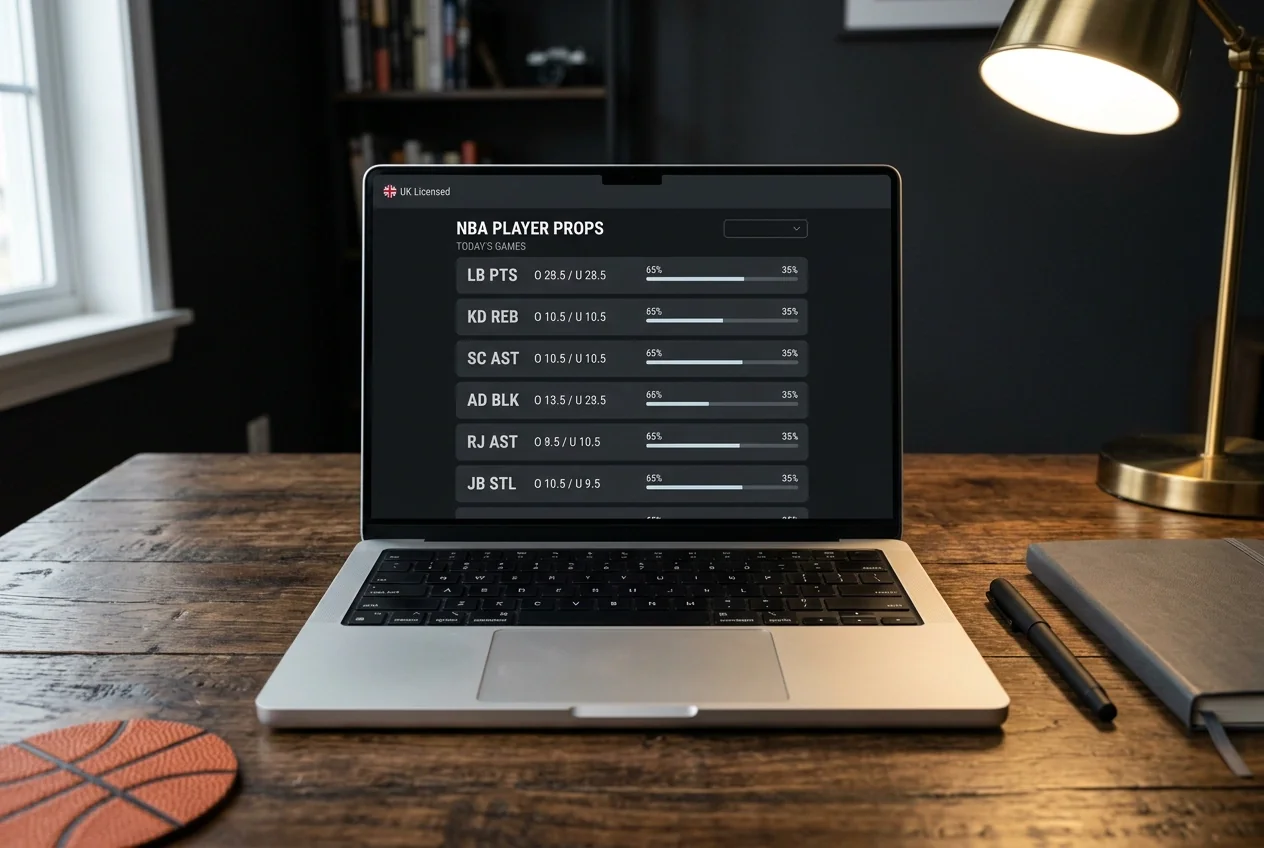
Start with the licence. Every legal sportsbook serving UK residents must hold a remote operating licence from the UK Gambling Commission. There are 1,786 regulated operators on the UKGC register, and a public lookup will tell you in thirty seconds whether the brand on your screen is one of them. If a site does not appear, walk away.
Once licensing is confirmed, the comparison narrows to product fit. UK PPC data from April 2026 shows Ladbrokes leads sports betting visibility at 36.8% click share, with Sky Bet at 23.85%. The Flutter Entertainment group — Sky Bet, Betfair, Paddy Power — generated more than $2.8 billion in UK and Ireland sports betting and iGaming revenue in 2023, with a 2025 forecast around £2.36 billion. bet365 Group recorded £3.72 billion for the financial year ending 31 March 2024. Those numbers describe scale, not prop quality. Search visibility is bought, market share is fought for, and neither tells you which operator has the deepest player special menu on a Tuesday in January.
| Comparison criterion | What to look for | Why it matters for NBA props |
|---|---|---|
| UKGC licence status | Active remote licence on public register | Non-negotiable baseline; everything else is moot without it |
| Prop menu depth | Number of distinct markets per starter | More markets means more line-shopping surface |
| Alt-line availability | Multiple half-point steps above and below the main line | Lets you express a confident view at better odds |
| Bet builder pricing | Transparent correlation handling between legs | Reveals how sharply the operator prices same-game multis |
| Withdrawal speed | Stated processing window, payment-method fit | Bankroll mobility matters more than welcome offer size |
| In-app responsible gambling tools | Deposit limits, reality checks, GAMSTOP integration | Mandatory under UKGC, but execution quality varies |
I do not bet a single pound through a site I have not personally tested for at least two weeks at minimum stakes. The interview process: register, verify identity, deposit a small amount, place ten to fifteen prop bets at recreational stakes, request a withdrawal, observe how long it takes. If the bookmaker fails any step, the account closes and the deposit is the cost of the lesson.
Welcome bonuses are a marketing line item, not a strategic factor. Wagering requirements mean the headline number is rarely worth what it sounds like. Treat welcome offers as a tiebreaker between two equivalent operators, not as a deciding factor.
One more practical point. Cash out is heavily marketed but rarely worth taking on a prop. The price an operator quotes mid-game is calculated by their model, which is at least as conservative about your remaining edge as you are about its current state. If you took the bet at +EV pre-game and the player has met half his line in the first quarter, your true win probability now is materially higher than the cash-out implies. The full operator-by-operator breakdown sits in our deeper comparison guide for UK-licensed sportsbooks on NBA props.
What UK Regulation Means for Your Prop Slip in 2026
An American friend who bets US props was visiting last spring and asked, after watching me decline a deposit limit prompt for the third time, whether the regulator was always this present in his betting flow. Yes. This is what consumer protection looks like when it is built into the product rather than printed in fine text.
Two regulatory shifts changed the financial geometry of UK gambling in 2025. The statutory gambling levy came into force on 6 April 2025 and applies to every UKGC licensee. Remote operators pay 1.1% of leviable amount; non-remote operators pay between 0.2% and 0.5%. The levy funds research, prevention and treatment of gambling harm, replacing a voluntary contribution model. For the bettor it is invisible at the point of sale. For the operator it is real money out of margin.
RTS 12 on financial limits came into force on 31 October 2025. The rule prescribes how operators must offer and display deposit limit tools. Before RTS 12, deposit limits were available but inconsistently surfaced. After RTS 12, the prompts are mandatory at predictable touchpoints. If you bet on a UK site and have not set a deposit limit, that is now a deliberate choice on your part.
Online slot stake limits. A separate change took effect on 9 April 2025. Online slot stakes are now capped at £5 per round for players aged 25 and over, and £2 per round for the 18 to 24 bracket. The relevance to NBA prop bettors is indirect, but it reveals the regulator’s posture: tighter caps on the highest-velocity products, with a special tier for younger users.
The institutional landscape is substantial. The UK has 1,786 regulated gambling operators and 8,234 licensed gambling premises as of the April 2024 to March 2025 reporting period. The Gambling Survey for Great Britain Wave 2, covering April to July 2025, found 10% of UK adults placed an online or app-based bet on sport or racing in the past four weeks.
Three things every UK NBA bettor should treat as standing requirements. One, an active deposit limit set at a level meaningful to your finances. Two, identity verification completed at registration. Three, an awareness of self-exclusion options including GAMSTOP, which sits across all UKGC-licensed operators. None of these reduce your edge. They reduce your downside.
None of this changes the maths under a prop slip. It changes the environment. The 52.4% break-even rule still applies. The hit rates by stat type still apply. What is different is that the operator on the other side is operating inside a tighter ruleset than the equivalent sportsbook in most other jurisdictions, and that is, on balance, a feature.
Why UK Demand for NBA Props Has Exploded
I drove past the O2 the morning after the 2026 London Game and the queue for branded merchandise was still wrapped around half the building. The fixture had ended at one in the morning local time. Nobody was supposed to be there at nine. That is when the UK basketball demand picture stopped looking like a forecast and started looking like a fact.
The 2026 NBA London Game between Memphis Grizzlies and Orlando Magic on 18 January became the most watched NBA London Game in European history on Prime Video, with viewership up 90% versus the 2019 fixture. The arena sold out at 18,424. Wider season-on-season UK Prime Video growth ran at 444% year on year for the 2025-26 season.
+444%
UK NBA viewership growth year on year on Prime Video for the 2025-26 season
18,424
Sell-out attendance at the O2 Arena for the 2026 London Game
1.5 million
Britons playing basketball at least twice a month, the second-largest team sport after football
Underneath the broadcast figures sits a participation story. Around 1.5 million people in the UK now play basketball at least twice a month, making it the second-most-played team sport after football. That is the input that produces viewership statistics — people who play the game watch the game, and serious watchers eventually look at the prop menu.
The EY-Parthenon Sports Engagement Index 2025 captures this through its UK and Ireland sports lead: “The 2025 EY Sports Engagement Index highlights a dynamic and evolving UK sports landscape… The rapid growth of Basketball among Gen-Z, driven by digital content and live experiences, underlines the importance of innovation in fan connection.” That sentence identifies the demographic engine and why the audience is sticky rather than seasonal.
The 2019 London Game between New York Knicks and Washington Wizards was, at the time, considered a successful piece of NBA Europe outreach. The 2026 fixture beat its viewership by 90% and sold out an arena seven years later despite a midnight UK tip-off.
For the prop bettor, the meaning is straightforward. Rising audience plus stable supply means rising liquidity, and rising liquidity means more competitive lines on more games. UK operators that ten years ago carried a single moneyline market on most NBA fixtures now carry full prop menus on most starters. The product caught up to the demand. The deeper cut on the UK NBA scene as a whole — media-rights structure, the London Game’s competitive impact, the demographic shape of the audience — is the territory of our companion guide.
A Pre-Bet Workflow: From Box Score to Confirmed Slip
The single biggest improvement in my prop-betting record came from one boring change. I wrote down the steps I had been doing in my head, in order, and forced myself to follow them every time. The bets that lost discipline were always the ones I placed in the last fifteen minutes before tip-off, and the workflow exists to remove that window from the decision space.

Six steps, in this order, no skipping.
Step one: confirm the player is playing
UK tip-off times mean prop slates close while you are asleep. Always check the official injury report in the last hour before close. If a player’s status is questionable, the line is moving on every alert and your edge estimate from three hours earlier is now noise.
Step two: read the pace context
Pace is the multiplier on every counting stat. The gap between a 93-pace game and a 105-pace game is roughly 12 extra possessions per game, which translate proportionally into points, rebounds and assists. A points-over line that looked tight at average pace can look loose when projected pace is two standard deviations above the player’s season norm.
Step three: read the matchup
For a points prop, which defender draws the assignment and how that team plays defence at the player’s position. For a rebound prop, the opponent’s three-point attempt rate and field-goal percentage. For an assist prop, whether the opposing defence switches on screens (kills assist opportunity) or stays home (preserves it).
Step four: form your true probability estimate
You are estimating the percentage of the time the player goes over the line tonight. If your estimate is 56% and the implied probability is 52.4%, the bet has roughly +6% expected value. If your estimate is 53.5%, your edge is inside the noise of your own model. Skip that bet.
Step five: shop the line
Rarely do all UK operators carry the same number. A points line at 24.5 on one site might be 25.5 on another. That single half-point can swing implied probability by three or four percentage points. Always check at least three UKGC-licensed operators before placing.
Step six: size the bet
If steps one through five came up clean, place the bet at a sensible fraction of bankroll — for most recreational bettors, between 0.5% and 2% per slip. The serious version is Kelly fractional sizing, but a flat unit system at the lower end of that range will keep most UK bettors out of trouble for an entire season.
Pre-bet checklist for any UK NBA prop
- Player confirmed active in the last hour before tip-off
- Pace projection for the fixture compared to player’s season norm
- Defensive matchup checked at the player’s position
- True probability estimated as a number, not a vibe
- Estimated edge of at least 4 percentage points over implied probability
- Line shopped across at least three UKGC-licensed operators
- Stake set as a fixed fraction of bankroll, not a feeling
Do
- Place bets earlier in the trading day when lines are softer
- Track every bet in a spreadsheet with stake, line, odds and result
- Walk away from a slate when nothing clears your edge threshold
- Treat injury news as a reset of the entire workflow
Don’t
- Chase a losing day with bigger stakes on later games
- Place a prop on a player you have not watched on tape this season
- Believe a single hit-rate split on its own — the 69.9% blocks number across 10,580 props is a sample-wide average, not a guarantee
- Take cash out on a winning prop just to lock in feelings
The workflow exists to convert betting from impulses into a process. A process you can audit, refine and repeat. It will feel slower in the first month. By the third month, you will not place a slip without it.
Integrity, the Rozier Case and What It Changed for Prop Menus
October 2025 was the month prop bettors stopped pretending micro-markets were a side issue. Federal prosecutors in the Eastern District of New York filed charges in a sprawling case involving an NBA player and a betting conspiracy across multiple seasons. Joseph Nocella Jr. put it bluntly: “This scheme is an insider sports betting conspiracy that exploited confidential information about National Basketball Association athletes and teams.” The prosecution did not allege a corrupt outcome of a basketball game. It alleged corrupt prop bets timed around insider knowledge of a player’s exit — exactly the soft spot the prop market exposes.
The financial scale was substantial. Prosecutors alleged bettors took home tens of thousands of dollars from inside information about an early player exit during a specific 2023 fixture. The FBI’s account, delivered by Director Kash Patel, expanded the picture to a multi-year scheme estimated to have generated tens of millions of dollars in illicit profit.
The league’s response treated the issue as structural. On The Pat McAfee Show, Adam Silver said the quiet part out loud: “It’s too easy to manipulate something which seems otherwise small and inconsequential to the overall score. Maybe it’s the couple rebounds that some player gets or whatever. We’re trying to put in place, working with the betting companies, some additional controls to prevent some of that manipulation.” He is signalling that integrity rails on prop products will tighten.
For UK bettors, the practical concern is not that the next prop slip is corrupt. The integrity monitoring infrastructure that flags suspicious pre-game patterns is, on the evidence of the 2025 indictments, working. The concern is product reach. Operators that previously offered deep micro-prop menus may narrow them — the regulator and the league preferring fewer attack surfaces over wider product range.
What changed on UK menus through late 2025 and into 2026 was real but less dramatic than the headlines implied. Operators have not pulled standard full-game props on points, rebounds, assists or PRA. Those markets are heavily traded and structurally hard to manipulate. What has tightened is the further-out micro layer: same-quarter player props on rare stats, in-game derivatives that resolve on a single possession.
How to read integrity stories without overreacting. A flagged piece of suspicious betting is not evidence the average prop bet is rigged. It is evidence the monitoring infrastructure caught what it was designed to catch. The cases that surface in the press are the ones the system flagged. The much larger volume of normal prop betting that the system does not flag is the baseline.
The full operational detail on how integrity events get reflected in settlement rules, void clauses and prop-menu changes is the territory of our dedicated integrity and settlement guide.
Responsible Gambling Tools UK Bettors Should Actually Use
Around 0.5% of the UK adult population meets the clinical threshold for problem gambling. That is a small percentage and a large number of human beings. The tools UKGC operators are required to provide are not a regulatory checkbox. They are the difference between a hobby that stays a hobby and one that does not.
The peer-reviewed evidence on younger bettors is precise enough to be uncomfortable. A 2024 study on sports betting marketing among 18-24-year-olds put it this way: “Sports betting marketing appears to be implicated in young people’s gambling problems. Specifically, young people who have gambling problems may be more likely to bet in response to advertising, and betting incentives may contribute to an intensification of their gambling behaviour.” Promotional intensity acts as a multiplier on whatever underlying vulnerability is already present, and the protective tooling exists to interrupt that multiplier.
Since 31 October 2025, RTS 12 changes have made deposit-limit prompts mandatory at predictable points in the customer journey. The operator now surfaces the limit option by default. Your default should be to accept the prompt. A deposit limit set sensibly relative to your monthly disposable income is the single most effective tool in the box, and the one the smallest fraction of bettors actually configure.
The tools that work are the ones you set when you are calm, not the ones you set after a losing day. A deposit limit configured during account setup is a structural commitment to your future self. A deposit limit you raise on a Tuesday night because the prop you really want is bigger than the cap is the opposite of a tool.
Do
- Set a monthly deposit limit at registration, before you place a single bet
- Use reality-check intervals to break long sessions and stop autopilot
- Use time-out periods when you notice you are betting differently than usual
- Treat self-exclusion through GAMSTOP as a legitimate option rather than a last resort
Don’t
- Disable session reminders because they interrupt the live betting flow
- Bet at stakes that scale with mood rather than with bankroll
- Treat the welcome offer as a reason to deposit more than you planned
- Bet on sports you do not watch, because the absence of context turns betting into pure gambling
If you find yourself reading this section twice, especially the don’ts column, that is information. Treat it as such. The line between recreational prop betting and a problem is not a single dramatic moment — it is a slow erosion of the boundaries you set when you started. There is no embarrassment in using the tools.
Where to Go Deeper: Strategy, UK Scene, Integrity and Tools
This article is the wide-angle view. The depth lives in five companion pieces, each pulling apart a single piece of this map. Every one has been referenced in the relevant section above.
Strategy
Pace, usage rate, defence-versus-position, hit rates by stat across a 10,580-prop sample, and how to fold all of it into one edge score for a single fixture.
UK scene
Prime Video viewership growth, the 2026 London Game in numbers, what the EY engagement index measures, basketball participation in Britain, and what rising audience does to UK prop liquidity.
Integrity and rules
Settlement clauses, void rules, the overtime question, the early-exit-injury edge cases that decide whether your slip pays out, and what changed on UK menus after the 2025 indictments.
Calculators and maths
Implied probability, no-vig fair value, expected value step by step, Kelly Criterion sizing applied to UK fractional and decimal odds, and a minimal tracking spreadsheet.
UK-licensed sportsbooks
The six-criteria comparison framework for UK-licensed operators in 2026: licence baseline, market depth, alt-line availability, bet builder pricing, withdrawal speed, in-app responsible gambling tooling.
Frequently Asked Questions About NBA Player Props in the UK
Seven questions that come up almost every week from UK readers. Each answer points back to the section above where the topic is dealt with at full depth.
What is an NBA player prop bet?
A wager on an individual player’s stat line — typically points, rebounds, assists, threes, blocks, steals, or a combination — independent of which team wins. UK operators often label these markets “player specials,” but the structure is identical to what US books call “props.” The bet usually resolves on a half-point line, settling clean as over or under.
What does PRA mean in NBA prop betting?
PRA is points plus rebounds plus assists, the most common combination prop on UK menus. The line is set on the sum of all three stats for a single player across the full game. PRA tends to be among the most efficiently priced markets, with a 54.7% hit rate across the 10,580 props analysed for the 2025-26 season — only marginally above the 52.4% break-even rate.
What happens to my prop bet if the player gets injured in Q1?
The default rule on most UKGC-licensed operators is that the prop is voided and the stake refunded if the player fails to play, or in some cases fails to record a single counting stat in the relevant category. The exact threshold varies by operator and market type — reading the T&Cs before confirming the slip is worth two minutes. Some operators settle as a loss if the player has met the line before the injury; others void regardless.
Which UK-licensed bookmaker is best suited for NBA player props?
There is no single answer. The right operator depends on which prop categories you bet most often, how deep an alt-line menu you need, and how much line shopping you are willing to do across multiple accounts. The framework: confirm UKGC licence on the public register, count distinct markets per starter, check alt-line availability, test the withdrawal flow with a small amount before committing serious bankroll.
How is a prop bet different from a moneyline or spread bet?
A moneyline bet picks the winner. A spread bet picks the winner against a points handicap. A prop bet ignores the fixture result entirely and settles on a single player’s individual performance. The research surface is much narrower — one player rather than two teams.
Are NBA player props legal and regulated in the UK?
Yes, on UK Gambling Commission-licensed sportsbooks. Player props are a legal product category and have been for many years. The consumer-protection requirements — deposit limits via RTS 12, statutory levy contribution, identity verification, GAMSTOP integration — apply uniformly to every operator on the UKGC register. An overseas-licensed sportsbook not on that register is not a legal option for UK residents.
How do I convert American −110 odds to UK fractional?
American −110 corresponds to UK fractional 10/11 and decimal 1.91. The implied probability is 52.4% on all three. The shortest mental conversion: divide 100 by the absolute value of the American number, which gives the fractional ratio with 100 underneath, then simplify. 100/110 simplifies to 10/11. For decimal: 1 + (100/110) = 1.91.
If a question is not above and you cannot find it answered in the relevant section, the answer is most likely sitting in one of the five companion pieces signposted in the section above. Anything that needed an extra two paragraphs was moved into the place it belongs.
Closing the Slip: Discipline Beats Picks
I told a fellow analyst at a screening event in Soho last winter that I had not placed a single prop on the most-watched fixture of the previous week. He looked surprised. None of the lines I tracked that night cleared my edge threshold, and the workflow had been clean enough to tell me so before I reached the slip page. The discipline of not betting on a Tuesday is invisible to anyone watching from outside, and it is half of the entire game.
If you take one thing from this article, take this. The bettor who treats every fixture as a hunt for a positive expected value bet, and who walks away when nothing clears, will outperform the bettor with better information and weaker discipline by a wider margin than feels reasonable. The hit rates by stat type, the 52.4% break-even rule, the workflow checklist — none deliver edge on their own. They deliver edge when applied consistently across a season.
The phrasing I keep coming back to was put well in a piece on prop maths late last year: “Uncertainty is part of the analysis. Don’t pretend you know true probability with precision you don’t have.” The model is an estimate. The bet is a decision under uncertainty. Discipline is what gets compounded over hundreds of those decisions.
UKGC-licensed product, sensible deposit limits, a workflow you actually follow, an honest read of the maths, and the willingness to pass on slates that do not clear your threshold. That is the entire job for a UK NBA prop bettor in 2026. Pick well, but build the process to outlast picks.
Created by the ”nba Props Betting” editorial team.